Showing posts with label speedlite. Show all posts

17 April 2009

Slave Speedlite tips

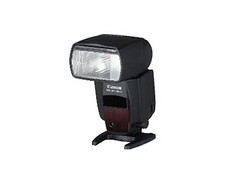
430EXIIWhen using the Canon wireless flash system people work in one of two incompatible ways. They put the slaves in manual and set the power on the slaves individually, or they leave the slaves in E-TTL and then use either manual or E-TTL II on the master flash.

If you set the power of the slaves individually in true pure 'strobist' style then you have precise control and can in effect have more than the standard 3 groups of flashes. One flash at 1/128, one at 1/32, one at 1/4 and another at 1/2 power is all possible. Indeed this is the only way to work if you need this level of difference in power outputs. Problem is that to change the power levels you need to go round to each individual slave and make the change.

If you leave the slaves in E-TTL and assign them to the groups A, B and C; then from the on camera master flash such as the Speedlite 550EX, 580EX or 580EX II you determine the settings of each of the flashes in the slave groups. The only important thing is to note or remember which slave is in which group. For ease if you put A slaves to camera left, B slaves to camera right and the C as a background or hair light you don't go far wrong. You can have more than one slave in the same group if needed. 
Put the master flash in manual and then you can set the power level of each A, B and C group of slaves from the master. Leave the master in E-TTL II and use the ratio controls to balance A:B and the flash exposure compensation to adjust the strength of group C. 

In this second approach with the slaves assigned groups and left in E-TTL it makes it possible for a group of photographers to work in either style. The all manual strobist photographer can set the power output for his shots by adapting the power on his master flash, and other photographers can use E-TTL II with ratio control for theirs. Just recently on a model shoot outside we tried exactly this setup, and everyone got the results they needed. The slaves simply take the information from the master that communicated with them last and do what they are told switching from manual power outputs to E-TTL II outputs and even high speed sync as necessary.


-blabpictures-

9 April 2009

The Hot Shoe Diaries

We've mentioned Joe McNally before and despite being a Nikon photographer (everyone has a cross to bare) he's a damned fine photographer... proof that it is possible to transcend the limits of a camera and still make good pictures! ;-)

Anyway, he recently published a new book called "The Hot Shoe Diaries" and is all about big light from small flashes. While it may be heavily Nikon-centric, it gives a great insight into how Joe makes his stunning pictures and if nothing else provides an enormous amount of inspiration to get out there and do it.

He walks you through his lighting process and while he may travel with enough small lights to stop a Nepalese sherpa, he devotes 110 pages to shooting with one light. Yep, one light is apparently all you need!

If you've been thinking about doing some more of the strobist stuff, then we strongly suggest picking up a copy.


-blabpictures-

30 March 2009

Speedlite masters and slaves

For some photographers, the concept and details of wireless Speedlite flashes is simple and they just get on with it. However for a large number it's a minefield designed to trap the unwary, and make photography with flash absolute hell.

Today we'll kick off with a short list of Canon flashes that can be used in a wireless Speedlite flash system. All kinds of wireless flash systems need a single leader to tell the rest of the flashes what to do, in Canon terminology this is the master. Following the obvious all the subservient flashes employed in the wireless flash setup are known as slave flashes.

All the following models can act as masters, controlling the slaves;
  • Speedlite 580EX II
  • Macro Ring Lite MR-14EX
  • Macro Twin Lite MT-24EX
  • Speedlite Transmitter ST-E2
  • Speedlite 580EX
  • Speedlite 550EX

All of the following models can act as a slave flash
  • Speedlite 580EX II
  • Speedlite 430EX II
  • Speedlite 580EX
  • Speedlite 430EX
  • Speedlite 420EX
  • Speedlite 550EX

Seems mostly typical that the current models of flash that are masters outnumber the slaves.

One question that some people ask is how many slaves can you control from one master. Generally Canon suggests the limit is seven slaves for each of the three groups that some of the masters can control. However in practice more than this is possible, and blabpictures have successfully managed to trigger 11 slave speedlites from a single master. Typically the limits are practical rather than system specific, think how much space you need to put up 21 lights and aim them at the photo subject and then add in the range of the pulsed light transmission and you can see that for most practical purposes the system will suffice.

You should also check out the previous post about using the MR-14EX and MT-24EX as a master with custom function 5 on blabpictures.

To set the master / slave function the older flashes have a nice easy to find switch, the latest generation 580EX II and 430EX II make it really tough and use a scheme where you press and hold the Zoom button for about five seconds - Canon please can we have the switch back?

-blabpictures-

25 March 2009

The Danes were right!


Well, we had the rumours from Denmark a couple of weeks ago, then it all went quiet. It seems though, they were right. 
Canon today have announced four new products - two of them are the two new printers we told you about the other week that had been launched in America and Hong Kong - the other two, are a new camera - The EOS 500D - and a new flashgun - the Speedlite 270EX.

It seems that Full HD i s making a march on the EOS range. The new EOS 500D features a 15.1 Megapixel APS-C sensor and the ability to shoot full HD Movie clips. But that's not all - the movie mode has seen some changes from the EOS 5D Mark II. Now you have the option for 1080p, 720p for longer recording or VGA. 

The ISO range has had a tweak from the EOS 450D as well - it's now 100-3200 with expansion settings for 12,800! It's also featuring the lovely 920,000dot screen that has been featuring on all other new EOS models recently too. 

No word on availability yet, but as soon as we find out, we'll let you know. Price, though seems to be around the £869.99 mark based on a quick look at various retailers. 

The other new product is the Speedlite 270EX. This is an update to the 220EX, the pocket flash for light in small spaces. It takes the 200EX and improves on it by including a zoom and bounce head. It's aimed at PowerShot and entry-level SLR users looking to move up from the built-in flash without getting into the bigger, bulkier 430EX II or 580EX II. Powered from 2xAA batteries, it keeps the weight down too. 

Price at £149.99 it could be interesting for some users. Available in May. 


EOS 500D Press Release:
The new EOS 500D features a 15.1 Megapixel APS-C CMOS sensor – ideal for large detailed prints or enormous cropping possibilities. For shooting in near-dark conditions, the EOS 500D offers a high ISO sensitivity up to 3200 which is expandable to 12800, giving photographers the power to shoot in the dimmest light conditions. Outstanding noise reduction is made possible by Canon’s DIGIC 4 processor.

The EOS 500D heralds a new way for photography enthusiasts to capture their world. It pairs outstanding still image capture with Full HD 1080P video recording. For longer video shoots, users can also choose lower shooting resolutions of 720P or VGA. A built-in HDMI connection allows easy and instant review of images and movie clips on any compatible HDTV.

Every detail revealed
Exacting image preview and review is provided by a 3.0” Clear View LCD screen.The same screen as used on the acclaimed 5D Mark II, it features a 920,000 dot count – for ultra-detailed image review, accurate focus checks, and clear access to the EOS menu system. As well as aiding shooting from awkward angles, Live View mode includes contrast based and Face Detection AF options. Ideal for newcomers to digital SLR photography, these allow compact-camera style auto focus, with a real-time image displayed on the LCD.

Features at a glance:
-15.1 Megapixel APS-C CMOS sensor
-Full HD movie recording with HDMI connection for viewing and playback on an HDTV
-ISO 100-3200 (expandable to 12800)
-3.4 frames per second continuous shooting
-Max. 170 large JPEG images in a single burst
-3.0” ClearView LCD with Live View mode
-9-point wide area AF with cross type centre point
-High speed DIGIC 4 performance and superb image quality
-EOS Integrated Cleaning System

Speedlite 270EX Press release:
25 March, 2009: Canon announces the launch of the entry level Speedlite 270EX, an enhanced flash designed for EOS and PowerShot users. Replacing the popular Speedlite 220EX, the Speedlite 270EX is aimed at photographers wanting to expand their flash photography beyond the built in flash and those who want a small: pocketable flash unit to complement their EOS-1D or EOS 5D series. The compact Speedlite 270EX builds on the success of its predecessor, with more power than usual for its class and size.

The Speedlite 270EX includes a host of new features not available with a built-in flash that push the boundaries for the entry level flash market. These include the addition of a zoom head, ensuring efficient light distribution and bounce flash head, enabling light from the flash to bounce off a ceiling to produce pictures with more flattering lighting with softer tones and depth. Improved circuitry offers near silent recharging and enables similar recharging times as its predecessor, despite being powered by just 2 AA batteries.

Pricing and availability:
The Speedlite 270EX is available from early May 2009 priced at £149.99 / €169.99 RRP inc. VAT.

Key Features include:
-High power flash with a maximum guide number 27 m
-Fast, silent recycle times
-Manual flash output (settable via camera menus)
-Speedlite controllable with compatible camera's menu
-Zoom head
-Bounce flash head

Hit the comments if either of these interest you. Or even just give us your thoughts! 

EDIT: we've just picked up one odd feature in the new camera - it seems if you choose to shoot in the Full HD setting of 1920x1080, the frame rate is 20fps.... if you go to 1280x720 or 640x480 it's 30fps as it is on the EOS 5D Mark II. We can only imagine that it's processing power that is stopping it shooting 30fps at 1920x1080. One up side of this though, is it shows Canon can change the frame rate in the movie mode....so, does it mean we could see 24/25fps on the EOS 5D Mark II as has been asked for by many? 

-blabpictures-

21 March 2009

High speed sync flash - leave it on all the time?

When you're shooting with a Canon Speedlite you usually get the option for high-speed sync flash. I prefer to leave high speed sync on all the time and here's why.

If you shoot sometimes in the daylight and need to overpower the ambient, then opening up the aperture to get plenty of power from the flash is nice, but you often end up with hitting the sync speed wall. Leaving high speed sync on all the time means you just keep on driving through that wall. The only downside is that the flash power falls off the faster your shutter speed goes.
If your sync speed is 1/250s then at 1/500s your flash is half as powerful and at 1/1000s then a quarter of the power is yours and you don't get warnings to this effect in the camera so you need to keep an eye on the shutter speed.

Don't forget that if you go for manual power control on the flash or second curtain sync then you lose the chance to have high speed sync.

-blabpictures-

12 February 2009

Wireless flash tip with ST-E2

Wireless flash can be quite a confusing thing. Most people seemingly don't understand how to use one flash properly, let alone two, three or more. But, once mastered, flash opens up creative possibilities the like of which you've never seen before. For proof, just hop over to Strobist and see for yourself. 

Now, there are several ways of controlling wireless flashguns in the Canon system. My personal favourite and the most versatile is to have a Speedlite 580EX II on camera and use it as a non-firing Master controller. But that is an expensive option. Cheaper, and almost as versatile is the ST-E2 Speedlite transmitter. It doesn't have the same range as a Speedlite, but it is discrete and offers most functions you're likely to need in general shooting. It even acts as an AF Assist beam in low light - great if you're a gig photographer working in low light.

One issue with the ST-E2 though is that it doesn't control three groups of flashguns (
A, B and C) only two (A and B).... or does it? Well yes and no. There are two ways of looking at it:


blab:
Guide Number / Aperture = Range
Manual flash powers is one. The box to the right shows the basic calculation for flash powers. Simply take the guide number of your flashgun (580EX = 58, 430EX = 43, 220EX 
= 22 etc) and divide it by the aperture setting you want to use. This gives you the range your flash needs to be from the subject. You can then change the flash power manually to alter the guide number. This works because once you set a flash power manually in slave mode, it drops out of being in any group and then just waits for a trigger signal. So if this is method one, what's method 2?

Well, method two has some level of automation. If you use ratio control on the ST-E2, there is no triggering of a Group C flashgun. Try as you might, it won't happen. So what do you do? Take the ratio control off groups A and B and then you can use flash exposure compensation to brighten or darken a group C flashgun that will now fire. So there is now automatic flash exposure control from group A and B (with no ratio control) and also for Group C with Flash exposure lock. Cunning hey?!

Hit the comments with your thoughts....

-blabpictures-

5 February 2009

Canon E-TTL II flash: why you should use Canon lenses

Could your choice of lens can cause instability in the flash metering of your camera?
If you use Canon lenses they talk to your camera body providing all kinds of information to help the camera determine the correct shutter speed to reduce camera shake, the maximum and minimum aperture of the lens and also in many cases the distance to the subject. This communication is Canon's own protocol, and whilst third parties have re-engineered it with some success did they get all the information right?

So how does the lens affect the flash?
Canon's E-TTL II flash metering added the use of distance information to the calculation of the required flash output power where the lens provides distance info. Some older Canon lenses don't provide distance information so the algorithm has to work without this valuable information to retain compatibility. Consider what happens if some third party lenses appear to provide distance information, but actually don't provide it in the way Canon expects it. Could be as simple as Canon lenses tell the distance in meters, Sigma maybe in feet. So Canon lens says subject is 4 meters away, approximately 13 feet. Sigma may say 4 feet away or 1.2 meters! The camera just gets 4. You can guess how this info may make the flash exposure wrong. It could be worse though; what if the Sigma always said the lens was focussed at 4 meters. Sometimes it would be right, sometimes wrong giving inconsistent results. With under exposure, over exposure and correct exposure at different subject distances.

We've heard several times of the two Canon EOS users with the same flash, same camera and different lenses having random flash exposures on the non-Canon brand lenses. What's more swapping lenses moves the problem too.

With exclusively Canon lenses on hand this is a tough one to prove, but we welcome your feedback in the comments.


-blabpictures-

15 January 2009

Speedlite external metering a new name for thyristor flash

580EXIIThis is a look at an often missed function of the Speedlite 580EX II flash, but first a bit of a history lesson.

Recalling the times before digital, the days when there was no electronic communication between lens, camera and flash. Back in those days photographers relied on each part of the camera system to perform optimally on it's own; frequently with manual input from the photographer to ensure needed info passes from one device to another. A flash I owned had a blue and orange scale on the back and a matching switch with blue and orange positions. The blue corresponded to f/8 and the orange was f/4. There was a range of distances that the flash could reach for each of the settings. All that was needed was to set the aperture on the camera lens to either f/4 or f/8 to match either blue or orange on the flash. The flash fired, measured the light coming back and quenched the output when it decided enough light had been output; often it was linked with the term thyristor after the semiconductor switch that was used in the circuitry. 

Some photographers in more recent times used big old hammerhead Metz flashes and they had a similar arrangement often with a big distance scale dial on the top of the flash head; mostly these guys were wedding photographers with a medium format film camera.

Enough of the history, many of those medium format camera wielding photographers now have a digital SLR and they complain that these modern flashes don't work as good as their old one.

That brings us to the Speedlite 580EX II, it's the first Canon EX model Speedlite that has the self-same thyristor function, Canon call it external metering sensor and hide it in the flash custom functions.

Flash Custom Function 5, flash metering mode has four options, the last two 2: External metering: Auto and 3: External metering: Manual are the new "thyristor" modes. The Speedlite 580EX II has a little circular window on the front lower left corner on the picture above, that's the sensor that measures the flash and tells the flash gun when to stop firing in these thyristor or external metering modes. Remember to point that window at the subject when you use these modes!

2: External metering: Auto
Wth this setting the flash will be sent the ISO speed setting and the aperture in use from the camera automatically. Using this the flash works out the range and will indicate it in meters or feet on the back of the flash display panel. Even flash exposure compensation can be set. When the picture is taken the flash will fire and the metering of the light reflected from the scene is measured by the Speedlite 580 EX II's sensor, not the cameras metering. Also this means you don't see a pre-flash it's not needed.

3: External metering: Manual
With this setting the flash performs like the "good ole" Metz models of yesteryear. You need to tell the flash the aperture you want to use, you need to tell the flash the ISO speed you are using and then it works out the distance and will show the range scale on the back. When the picture is taken the flash fires and the metering sensor quenches the light when the flash determines enough light. You also don't get a pre-flash. Even better for the low tech, you can put the PC socket on the side of the flash to use and fire the flash with a PC sync cable or even a pocket wizard.

To get the custom functions on the flash, press and hold the Cfn button on the flash and perform a great sequence of dial turns and button presses to set Cfn 5 to 2 or 3. Alternatively if you have one of the following EOS models EOS-1D Mark III, EOS-1Ds Mark III, EOS 5D Mark II, EOS 50D, EOS 40D, EOS 450D or EOS 1000D you can put the flash on the hotshoe and go in to the camera menu for flash control and set the flash custom function there.

One application of the External metering: manual setting is for light painting. If you think that you want to light up that big building at night and you only have one flash, then set the camera on a tripod, choose the aperture and ISO, select bulb mode, open the shutter with a remote release and then walk around the scene firing the flash using the test button on the back to light each part of the scene.

-blabpictures-

6 January 2009

Guest tog Tuesday - James Corrin

Our first Guest tog on Tuesday is James Corrin who describes himself as a 31 year old fashion / alternative fashion / gothic photographer from Aylesbury UK. We asked James a few questions from a big list to kick things off.

BLAB: Natural light or flash and why?

JC: Almost without fail, flash. However, if you'd asked "available light or flash?" the answer would be "both".

There have been two things which really changed my photography. One of these was digital cameras, which makes the learning process so much easier (and removed film processing companies from the loop mercifully). The other was studio flash. Learning about flash really opened my eyes to light as a whole in photography, funny though it may sound - before that point I just took what light there was and consequently I have many mediocre landscape photos to show for it. Studio lights put me back in control and reinvigorated my interest in photography - but more than that, once you learn to control light you also learn how to see light. I think learning about flash is one of the greatest things any photographer can do, after studying composition. I think this is part of the success story of Strobist - it's not only that David Hobby is teaching people how to use flash, but he teaches them how to see and study light.

To get back to topic, I tend to approach any photographic problem as an exercise in using flash. I can't help myself, it's fun and I just like how flash looks in a picture, especially the ability to get soft-but-not-flat light sources. I do much of my photography in a studio, so I can craft my light from scratch. When faced with natural light I tend to work out how to minimise its impact so I can bring out the flashguns and shift the highlight of an image. Having said that, I am increasingly looking to blend available light, especially artificial light sources, with flash. And there are some occasions, such as at gigs, where available light is better than reconstructing the scene using flash.

So I guess the answer is rather unhelpfully, whatever is most appropriate to the picture.

... and flash.


BLAB: Which photographer's work do you most admire and why?

This is a very difficult question. There are so many photographers producing great work now and I find the ones I admire most change quite rapidly. Chiefly I look for photographers within my own field; landscapes are great too, but I photograph what I like to see. I make a point of looking at a lot of other photos, to get ideas, study technique and also plot a path to my own style. I'm trying to avoid copying other artists and, though I do praise Strobist, I want to avoid the "Strobist look" that has become quite common on the web.

That said, if pushed to name my influences, I'd have to cite two photographers, unfortunately you may find some of their images not safe for work, you have been warned:

Nadya Lev - her work was a strong inspiration for some time and even now I find it highly inspiring. Her work is fairly hard to place, but high-fashion with historical themes and fetish overtones might get close. My early experiments with gels and gothic fashion were largely brought on by seeing her work.

Lithium Picnic who also has a large body of work on deviantart.com - LP is in a similar line to Nadya Lev, with strong fashion and glamour pictures with varying levels of fetish fashion scattered around. Where Nadya Lev produces bright works with strong colours and simple constructs, LP produces darker and more complex pictures with more subtlty. I wouldn't say Lithium Picnic was necessarily better than Nadya Lev or vice versa, but I think I discovered his work at a time when I was looking to produce more complex images myself. LP is very much a target for my pictures, not so much in content but in look, feel and production values.

BLAB: Which of your images means the most to you and why?

Many of the photos that mean the most to me are little better than holiday snaps, but they represent people, places and things that were important in my life. As a photo, they aren't so valuable.

At risk of sounding a bit "arty", I think this is where the highly constructed images I make differ from, say, journalistic images. Because I am photographing constructed scenes, especially ones that may not exist beyond the duration of the flash, the image content has no direct meaning to me. I saw the studio that day and it wasn't anything special. Instead the photo is judged on its final quality - does it capture a mood or a look, is it stylish or attractive? And because I'm aiming to improve all the time, the image that means the most to me changes all the time, usually to the most recent image made.

I worry when my most recent images don't mean the most to me!

There is one big exception though. Two of my friends got married at the end of last year and asked me to be their wedding photographer. We did some lovely posed shots with flash inside the wedding venue. This was a wonderful chance to capture a memory and also dress it up in light. There's something very special about capturing a beautiful image of a beautiful memory.

BLAB: What would your dream photo opportunity be?

So many to choose from, but if Gothic Beauty magazine phoned up and asked me to do a cover, I wouldn't be complaining!

BLAB: What colour would your Ferrari be?

JC: Black, but with plenty of shadow detail. ;)

Anything else..?

These are very exciting times for photography since the rise of digital cameras and photo sites like Flickr and Deviant Art. There's an incredible amount of high quality photography out there. The best part is that not only is photography more accessible but learning about photography is more accessible. I wish Flickr, Strobist, Cambridge in Colour and so many other sites existed when I started in photography - maybe I'd have fewer boxes of mediocre landscape photos.

With all this photography around, there is a real issue about how you differentiate yourself. When I started in portraiture, I rapidly became bored as it all started to look the same. I started becoming interested in fashion photography and in particular gothic fashion, playing with different styles and variations from the alternative photography and fashion communities. There's an interesting trend now for mainstream fashion to borrow increasingly from these communities, but I like to think that it still gives my images original themes. I love working with the extended conventions of the alternative scene in any case so I can't see me stopping that any time soon.

I once attended a photography seminar where the organiser asked "Who takes photos because they can't draw?" Everyone put their hand up. I think flash photography really opens up the possibility to be massively more creative. Certainly the turning point for my photography was discovering studio photography. Prior to that I didn't find people very interesting subjects, but this introduction to a world where I could construct the entire picture, from selecting models to placing them in light that I controlled, added the important creative element that I was missing before.

There's a great comment I saw from Chase Jarvis originally and many other people since. He said, there's two kinds of photographer - image takers and image makers. I would definitely say I'm on the image maker side. Going digital has been a huge boon as now the image making can happen after the camera - I know some experienced photographers dislike doing their own post processing and consider edits to be cheating, but I consider digital workflow a huge advantage. Photoshop is a great tool and most of my portfolio images pass through Photoshop at some point. The trick is getting good quality images going into the workflow then being subtle in the changes. I've been through many dilemmas of Photoshop vs in-camera editing before realising that both sides have something to offer.


BLAB: Ok but what about photos, got any pictures you'd like to show us?
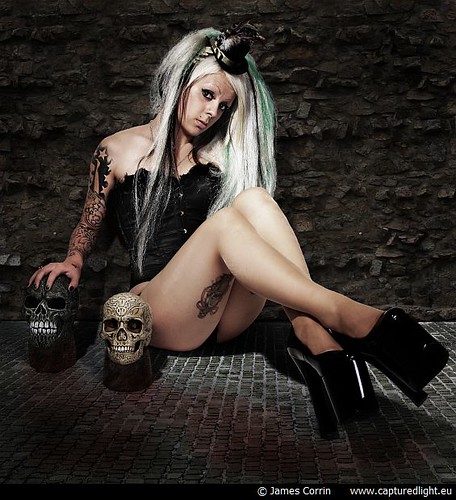

http://www.flickr.com/photos/captured_light/2848742273/in/set-72157603348085520/
This image of Ethel Hallow is one of my favourites and she's always great to work with. This image also represents one of my biggest Photoshop edits to date. I couldn't find a good backdrop for her so took this picture on a white seamless studio backdrop. The original image was subtly lit and brought into Photoshop as a low-contrast image. I then took some segments of wall and floor from some holiday snaps and extended them across the picture, adding contrast and highlighting as I went. The advantage of shooting on white originally was that the shadows of Ethel on the floor effectively come for free through Photoshop blend modes. ... The skulls are real by the way, in as much as they are kickable objects in the scene with Ethel.
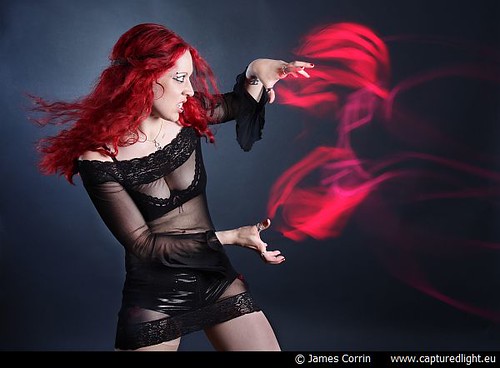


http://www.flickr.com/photos/captured_light/2848742135/in/set-72157603348085520/

This photo amuses me because most people assume the red light was created in Photoshop. In fact, though the image has been edited slightly, the red light is created using glowsticks. The entire image was a 30 second exposure with willing model Skarlett Venom standing still in a dark room while I waved glowsticks in the air in front of her. Towards the end of the 30 seconds I jumped out of the way and fired three studio lights - one softbox from Skarlett's front, one hair light to the left and a blue gelled light on a black paper backdrop.
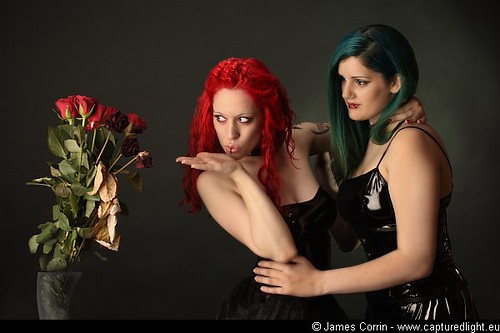


http://www.flickr.com/photos/captured_light/2079023381/in/set-72157603348085520/
One of my early, big-team studio efforts and my first time with a makeup artist on set. No-one quite seems to get the concept I had in mind for this shot, but so far it's fairly well received. Thanks to the cooperation of Skarlett Venom and Indira Diabola, not much editing was required on this image. The only big change was the vase - I couldn't find an interesting vase before the shoot so had someone hold the flowers up and drew a vase in Photoshop over the hand after the event. I've learnt more about drawing through Photoshop than anywhere else.
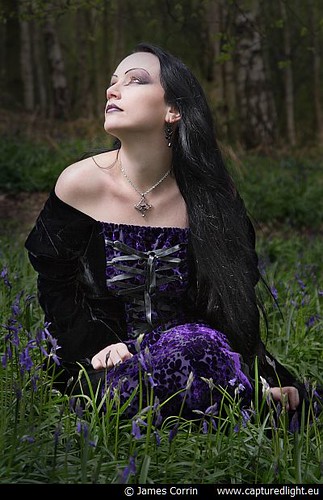

http://www.flickr.com/photos/captured_light/3168339659/in/set-72157603352325505/
This simple photo was taken outside on an overcast day. It's fairly true to the real view, but I did use a flashgun with brolly top-left to get a directional light on Amaranth's face. I've invested in a few Canon speedlites and find them invaluable for studio photography outside the studio. The wireless trigger isn't great in direct sunlight but a bit of cloud cover helps massively. A little Photoshop after the event brought out some more detail in the purple of the dress.
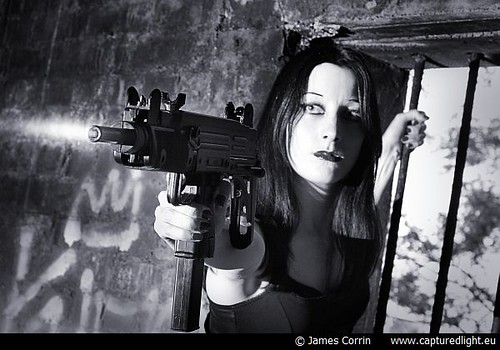

http://www.flickr.com/photos/captured_light/3168339669/in/set-72157603348085520/

I don't often work in black and white, but this picture of Marvada and her replica machine gun cried out for it. It was photographed on a sunny day but in a dark room, so the speedlites came out again to swap the lighting from window-inwards to room-outwards. I love being able to re-engineer light on set like that. The muzzle flash is a Photoshop extra - just in case I'm not bullet proof.

James' photography and writings can be found in several other places on the web, most notably his website, www.capturedlight.eu.
Then there is his flickr account www.flickr.com/photos/captured_light/and techie and photo blog: jordax.livejournal.com/

Wow what a start, think you want to be here on Tuesday, drop a message to us or comment on this post.


-blabpictures-
2 January 2009

Curtains and fire

second curtain sync
So it's 2009. As we told you yesterday, the aim for blabpictures is a post a day. We'll be trying to be interesting, informative and funny. It will be mostly Canon related, but we'll also have some general photography coverage as well as posting stuff related to photography that we find interesting or worth telling you about. 

We'll be featuring 'togs, so you get to see some good pictures by other togs as well as hearing about their thoughts on photography. 

For today though, here's a little tip about second curtain sync flash and photographing sparklers.

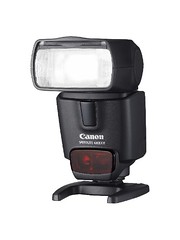
To do shots like this, you ideally need an external flashgun. In this case, a Speedlite 580EX II. This was mounted on the camera, and the exposure was set manually to 3.2secs at f16, ISO 200. These were set manually and you do have some flexibility with the settings, you just want to aim to have enough time for your subject to complete their image, without overexposing the sparkler.

I was shooting handheld, but there is no blur because during the exposure, there was not enough light to create blur on the main subject, and the sparkler was moving anyway. The flash was set to fire as second curtain sync flash so the main exposure on the subject (the girl with the sparkler) was created by the flash at the very end of the exposure, just before the shutter closed. The flash froze her movement resulting in the sharp image of her overlaid by a treble clef (yep, that's what it's meant to be!), even with a 5 second handheld exposure.

Shot with the EF14mm f/2.8L USM lens on an EOS-1Ds Mark III. 

-blabpictures-

30 December 2008

Off camera cord OC-E3 is your friend for wireless flash

It's Tuesday so I needed a photographer to feature, but in lieu of some photographer here's a tale of how even the simplest accessory can be your saviour in times of need.

The humble off camera cord OC-E3 sits on your hotshoe and connects the master flash to the camera. In fact the camera thinks the flash is on the hotshoe so you get all the control but now the flash is off camera and you can move it for better lighting. 

Just yesterday out on a shoot I was trying out some strobist techniques with a Speedlite 580EX II firing in to an umbrella high up on a lighting stand; nine or ten feet high up. The big problem was getting the flash in the umbrella to trigger reliably with the wireless from the on camera flash. Getting the on-camera flash on the end of the OC-E3 and in the hands of a VCA (voice controlled assistant) meant the assistant could hold the master and aim it at the high up Speedlite in the brolly and I could get on with the shooting. I was using the master flash only to trigger the slaved one in the brolly after all. The VCA let on later that he'd seen this kind of trick on Joe McNally's blog some weeks ago so a Nikon trick works on the Canon's too.

Some of you will think; that's a 60cm cable length only on that OC-E3, but remember you can daisy chain them together too for more reach. Another thing is that the older Off Camera Cord 2 also comes up on ebay a lot for little money and they work just as well. If you're handy with a soldering iron you can even remove the short 60cm curly cable and replace it with a longer length of ethernet patch cable. Off camera cord and wireless E-TTL lets me use high speed sync to kill the ambient a little easier than using a dumb trigger like an ebay trigger or pocket wizard.


-blabpictures-

19 December 2008

EZ Speedlites and EOS DSLRs

Does it work? In three words, yes and no.

A Canon digital EOS SLR will fire an EZ Speedlite. But, there's no automatic metering so you'll need to go back to measuring subject distance and aperture and setting the flash power manually. If this is you, then here's some formulae that may help:

Guide Number/Aperture = Range

Guide Number/Range = Aperture

Aperture x Range = Guide Number

And if you want to know the Guide Number of your Canon flash, look at the first two numbers in the model name. 580EX II = GN of 58. 540EZ = GN of 54. MR-14EX = GN of 14.


-blabpictures-

11 December 2008

High speed sync

Now this, this is all kinds of crazy. And no, I'm not talking about the fact that there is a double post today. This just had to be shared....

Many of you may know of a guy by the name of Joe McNally - a truly great photographer and someone who has mastered flash on location in almost every conceivable situation. Now we like Joe, even though he shoots Nikon... But for those that see his work and think "hmmmmm am I missing something with Canon and the flash system?" The answer is no and Syl Arena is the guy to prove it to you.

How does 1/8000sec sync flash in the middle of a bright day using Speedlite 580EX II flashguns sound? Interesting? Yeah, we thought so too. It seems that Syl managed to get hold of 12 580EX II flashguns on loan from Canon USA and a bunch of RadioPoppers as flash triggers and he built a ring light on a wooden frame. Well, he's calling it a ring lite, but it's more like a square light to me - but I'm just splitting hairs.

He used the RadioPoppers to trigger the Speedlites and so get enough power output for high speed synch at 1/8000sec. Pretty cool, huh?

So why would you bother? Well, high speed sync allows you to achieve a shallow depth of field when using flash in bright daylight with a fast aperture lens. Alternatively, you can turn day into night just by upping the shutter speed so you don't record as much ambient light.

We'll do more on high speed sync flash in a future post or two, but for now, we just wanted you to see this!

-blabpictures-

20 November 2008

Better depth of field control with flash and high speed sync

With Canon's cameras and add on Speedlite flashes you usually have the chance to set high speed sync or focal plane (FP) mode to let you shoot at shutter speeds faster than the cameras normal sync speed. Why not enable it all the time?

The idea of high speed sync is that the flash fires several times rather than just at the start or end of the exposure. It needs to do this as the shutter only uncovers part of the sensor at a time during the faster than sync speed shutter speeds. Think of it as a moving slit passing over the image, since that is actually what's happening.

With high speed sync enabled you can shoot at 1/500s at f/2 for depth of field control and have the flash fire to fill-in the shadows. The downside is that you lose a bit of flash power as it needs to fire several times during the exposure. In fact the faster the shutter speed the smaller the slit making the exposure and the more times it needs to fire during the exposure; so the less power.

Most of the time you need this faster shutter speed it's because you, the photographer is using a wide open aperture so the lower flash power is actually less of a problem than it might seem.

High speed sync is available on the Speedlite 550EX, 580EX, 580EX II, 420Ex, 430EX, 430EX II, Macro Ringlite MR-14EX and Macro Twinlite MT-24-EX.

-blabpictures-

7 November 2008

Using a Macro RingLite MR-14EX as a master flash

The Macro Ringlite MR-14EX and also the Macro Twinlite MT-24EX can work as a master flash in the Canon Speedlite system. Problem is they are mostly thought of as macro flashes and in the brains of the designers they are not configured to fire more than additional background flashes. In this post we'll explain how this can be improved upon.

These specialist flashes are great if you only want to use an addtional Speedlite 430EX II or 580EX II as a background illumination source with the slaves set in group C. If you are thinking a bit more creatively and thinking to use the MR-14EX as a low powered portrait ringlight then you may need to control some additional flashes in groups A or B linked to the tubes on the ringlite.

The key here is custom function 5 in the ringlite or twinlite. Setting this to 1 instead of the factory default of 0 will enable the flash to trigger other wireless speedlites in groups A or B. That's all for today's top tip.

-blabpictures-