Showing posts with label blab. Show all posts

21 April 2009

Featured 'tog Tuesday - John Lester

This weeks 'tog is landscape and nature photographer John Lester.

BLAB: Jumping straight in to the important question, what colour would your Ferrari be?

JL: I'd love to give the geek answer of 18% grey so I've got the coolest grey-card around, but I'd go for metallic Black. I understand the purists' point about red ones, but show some individuality! Besides, the sunset looks amazing reflected in a shiny black car.

BLAB: Can you tell us a little bit more about yourself?

JL: If I was to summarise my photography in just one area, it would be Landscape / Nature photography, but I enjoy other areas as well and am always looking for new projects and experiments.

My interest in photography started in 1988 when I was 10 and my parents bought me a Canon Sureshot point-and-click film camera for my birthday. It went everywhere with me and despite not having a zoom, I managed to get some pretty good nature shots - sneaking up on butterflies, grasshoppers etc. About 6 years later, I took my first shots with an SLR - a 3 frame panorama of Mount St. Helens (post eruption) using a manual Pentax SLR. I still have the pictures framed on my bedroom wall now.

On the strength of my little Sureshot, I decided Canon was the way to go so I saved up and bought a second hand EOS 1000F which I proceeded to improve my photography with. Purchasing various lenses and accessories gave me the opportunity to properly experiment with aperture, shutter speed, filters etc. I was fortunate to have a family who took me all over the world so saw wonderful things you can't get in the UK. I was also lucky to be egged on by a neighbour and now very good friend, Dr. John Davis, who has toted everything from Sony Cybershots to Leica SLRs and is currently using a Leica Range-finder as his main toy.

At University, I did the photography for one of the Sports Club Balls and sold prints from the event - that meant learning how to use, process and develop black and white film and prints. I spent DAYS in the dark room playing with settings. It was by no means profitable for me and in honesty was not hugely successful, but the money helped toward my EOS 5 which to date is my best camera.

In 2004 I went digital and bought an EOS 300D which still serves me well and nearly all my website pictures were taken with it. Despite going digital, I still believe that the skill of Photography lies in the camera and not in Photoshop. I make small adjustments to my images such as cropping and brightness, but nothing you couldn't do easily in a dark-room. I'm not knocking the Photoshop gurus out there but for me that's Digital Art rather than Photography.

I use Aperture on my Mac Pro for all my photo work. I've been a Mac addict since about 1985 and wouldn't dream of using anything else. My MacBook Pro comes with me on photo trips longer than one day and proves an invaluable tool for generating interest in what I'm up to.

I have no plans to be a full time professional photographer as I'm scared of turning my favourite hobby into a chore, but I am working toward selling a few prints / doing a few shoots to hopefully get my photography to pay for itself and maybe buy me the occasional bottle of winjavascript:void(0)e.

I put some pictures on my website, http://www.jalphoto.co.uk a few years back and really must update the site properly, it needs an overhaul so please do visit me, but also check back soon for an updated look at my work.

Right now, I'm doing some photography work with a friend of mine,James Corrin. He is teaching me how to do model shoots and I'm going to help him with his landscape work.

I've recently been made redundant from a small IT reseller so I'm using this time to work on things I don't get time to do whilst I look for a new job. If anyone works at Apple or needs an IT hardware sales guy....


BLAB: Back to the regular blab questions: If you had been paid ten thousand pounds for being our 'Tuesday tog', what photo equipment would you spend it on?

JL: Oooh toys!

  • Canon 5D mkII with 24-105mm F4 L IS (£2900) - This will be my next kit purchase as I've been dribbling over full frame since the original 5D was launched. I love wide-angle landscape work and the 16-35mm L lens I have is awesome, but just not wide enough on a crop sensor... I'm also looking forward to playing with HD video, but suspect that will be a minor part of the camera's use. The 24-105mm lens gives me something good for general purpose work with a very useful zoom range.
  • Apple 30" Cinema display (£1200). I have an Apple 20" Studio display now, but more pixels are required for playing with a 21MP camera.
  • Colour calibration kit (£100). I would like to be a little more accurate with my output. My Canon PIXMA printer is brilliant but is not colour accurate with my screen and that bugs me.
  • A handful of Sandisk Extreme IV flash cards (£500)
  • Canon EF 14mm f2.8 L lens (£1900). As I said already, I love wide angle landscape work.
  • Canon TS-E 45mm Tilt Shift Lens (£1100). I have no idea how these work but the results fascinate me so I'd love to play with one, especially on someone else's money :)
  • Three Speedlight 580 EXII Flash (£1000). Slave flash-lit work is another area I'd love to play in
  • Canon MR-14EX Macrolight ringflash (£450). I've got the Canon 100mm Macro which is probably my favourite lens, a Ring Flash would be very useful for me.
  • Two Elinchrom Freelight Ranger portable flash (£900). I want to get more into people photography, but want to combine this with my landscape work, so portable lights would make the list too.
BLAB: Sounds like that list is pretty well planned out, but which of your images means the most to you and why?


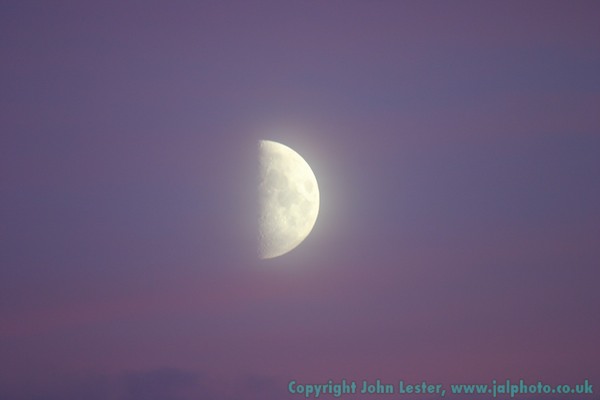
JL: This was taken beside Spirit Lake in Jasper National Park, Canada back in 2004. I love doing landscape photography and the wilds of Canada are just so perfect a playground. This trip was one of the last family holidays we took before my Dad died. He was a huge fan of the outdoors and this shot wraps up the awe and majesty of the Canadian Rocky Mountains.

As much as I hate to admit it, the location of this shot was luck more than judgement. We'd spent all day at the lake further up the valley with mostly cloud-laden skies and cool weather (even in August it's cold up there - it's only 3 months from snow melt to snow fall). We were just leaving for home when I saw this view in the wing mirror of the car. The sun had just broken onto the mountain in the foreground. I stopped sharpish and piled out of the car leaving my confused family wondering what had happened. The image is Canon's JPEG (I wasn't shooting RAW then as the camera was 2 weeks old and I didn't know what it meant) but otherwise untouched. The sky was that moody, the water that still. I was very lucky - I took just one exposure and got back in the car. Fortunately it worked.

BLAB: What would your dream photo opportunity be?

JL: I've got two - one that will never happen and one that I hope will.

My Dad was a Botanist and in 1995/96 was applying for budget to create a Flora of Yemen. If he'd managed to secure this, then I was offered the role of official photographer and would have spent 3 months trekking through the wilds of Yemen with a new macro lens and EOS 5 film camera and more film than I knew what to do with.

The opportunity I can still do (and am determined to one day) is to hit Fall in the maple forests of Eastern USA / Canada. This has to be one of the most spectacular events and presents so many photo opportunities.

BLAB: Pictures.... please?

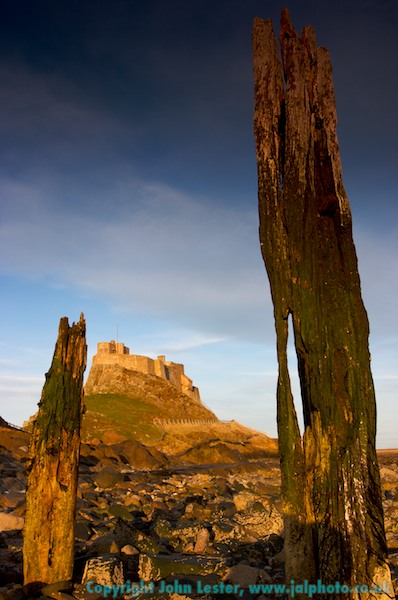
This was taken at midnight by Chun Quoit in Cornwall. I'd set out to take star-trail pictures by the Quoit but had not understood what thin cloud and a full moon would do to my exposures. 5 minutes looked like daytime. Green grass, blue skies, SHADOWS!!. I changed tack and worked on this picture which I like as it shows the undisturbed ancient-ness of Cornwall but with the modern world close at hand. The Quoit itself is "painted" with a standard torch to bring it out.

I took this picture with my newly purchased 100mm Macro lens. It's of some old winch gear in Lulworth Cove, Dorset. Rusted metal has a fascination for me - I think it's something to do with the colour and the fact that it's been abandoned.

I was in Slovakia on a 10 day photo holiday touring the countryside. Near the end of our trip we'd stopped in a tiny medieval town called Spisska Sobota near Poprad. I saw these Houseleeks growing in roof at eye-level and the lighting was perfect.
Taken in Trengwainton Gardens, Cornwall. It had been raining all day and with a very low, flat light there wasn't much jumping out at me. I found these flowers with water droplets on quite fascinating and took this hand-held, naturally lit shot. For me it shows the brutal sharpness and background blur of the Canon Macro lens

BLAB: Thanks to John for being this week's 'tog on Tuesday, if you want to be here in the future comment on one of the Tuesday tog posts with some contact info and we'll be in touch. Your contact details won't be published since we moderate all blog comments.

-blabpictures-

13 March 2009

Back button focus

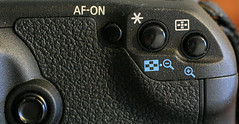
Exposure lockBack button focus is one of the functions on EOS digital SLR cameras that gives a new layer of control over the picture taking process. In simple terms it places the shutter release, exposure lock and focus lock or activation on up to three separate buttons. If you have only ever used the 'out of the box' configuration with the AF activated with the half press on the shutter and the AE lock occuring with the focus lock in evaluative metering and this is not suiting you then it may be something to experiment with - though it's an acquired skill.

Probably one of the best articles on the topic is actually on the Canon USA website in their digital learning center. The article highlights five often quoted advantages of back button focus;
  1. Easier to lock focus
  2. Easier timing of shots
  3. Less risk of focus errors with moving subjects
  4. Easier over-riding of AF with full-time manual focus
  5. Easier macro and close up focussing
With the latest EOS cameras from the mid-range up providing separate buttons for AF-ON and AE lock '*' then there's also a function to switch round the operation of the two buttons. Great if you plan on using back button focus on an EOS 450D and an EOS 50D, as the EOS 450D doesn't have the separate AF-ON button and then the placement of the buttons may be out of sync with the two cameras.

Some photographers find that the use of back button focus eliminates the need to switch between AI Servo and One-shot AF modes. They simply use AI Servo all the time and switch the AF off when they have the right focus for their picture.

You might also find the previous article on blabpictures about AE lock and the metering pattern valuable further reading.

-blabpictures-

18 February 2009

98... 99... 100 posts

A startling milestone for the blabpictures blog we've hit 100 posts, since starting blabpictures in November 2008.

It's been a time for a lot of photographers starting to learn and feel the pain of video making with the EOS 5D Mark II, and for us to learn the delights of getting contribution to the blog from the readers and photographers. Thank you indeed to our six featured togs on Tuesdays since January, we look forward to many more in the future. Leave comments if you want to be here.

BLAB PICTURES - EOS Experts
Creating this blog, we set out to give lots of expert tips, and indeed 23% of our posts have had the EOS Expert tip label on them. We've covered flash, metering, AF, WiFi and exposure modes with much more to come.

As the photo industry annual launch pad, PMA nears it can't be long until Canon shows it's hand and products that will have us all reaching for our wallets - either to stop the credit cards leaving or to let them have free rein.

Here's to the next 100 posts on blabpictures, join us on the journey and don't forget to tell your friends and fellow photographers about blabpictures.

-blabpictures-

27 January 2009

Featured 'tog Tuesday - Oliver Godby

This week's featured photographer is Oliver Godby, Oliver contacted us through the comments in reply to our first featured 'tog James Corrin.

Oliver's Biog
I’ve been taking photographs for around twenty-five years, but I’ve only been taking the pursuit seriously since I was about sixteen. A good friend of mine at school was considering submitting some of his photographs for a GCSE and looking at his portfolio and talking to him about how and why he had taken them I started to realise that I too could see another level to photography, beyond that of capturing a moment or a memory. I realised that one might create something larger and more meaningful with a camera; I have been trying to do that ever since.

Almost all of my photography revolves around people and or life. That’s not to say that I don’t often try my hand at landscapes, architecture and other disciplines, but I tend to find that time and again I return to what I seem to be best at; people. Whether we are talking about club photography, event photography, weddings, candid portraiture, portraiture, fashion, nudes, erotic or anything else involving people then I am interested in shooting it. For me, the way that I see people and the way that I try to express the wonder, beauty, darkness and light of the human experience through my photography is a necessary part of my passage through life; when others see something that they like or moves them in what I create then I am even happier.

Caution
Some of my current work is of a particularly erotic nature and maybe not appropriate for readers of the BLAB Blog in an open office. It is not my only interest by any means, but if readers are interested in seeing that side of my work, then please contact me via the website at the end of the article.

As is usual for featured 'tog on a Tuesday, we ask tough questions to see what makes the 'tog tick.

BLAB: What colour would your Ferrari be?

Oliver: Red, of course. I realise that a different colour would trumpet my individuality or something, but the truth is that a Ferrari should be red, even if they were originally all yellow. I used to despair of people in the eighties who bought the Testarossa, which means ‘Red Head’, and then ordered them in a colour other than red, but that’s just me…

BLAB: What's your best bit of advice for a new photographer?

Oliver: Take a camera with you everywhere you go and take lots and lots of pictures. With digital being the financial godsend that it is you can make a lot more mistakes without it costing you a fortune, but there is no point taking lots of pictures and making those mistakes if you don’t learn from them, so be prepared to get some criticism and __really__ listen to it. I can’t recommend Flickr enough for positive and constructive peer review.

BLAB: Rucksack or shoulder bag and why?

Oliver: When I started out in the world of digital SLRs I was all about the sling or shoulder bag, and I had an awesome one (that is no longer produced) called “The December Quarter” by Crumpler. I could fit two bodies and three lenses, plus a half decent sized laptop and enough clean underwear, socks and t-shirts for a weekend away without having to check my luggage. Can you see the problem? Yep it was an unwieldy bastard. So I started to look for the perfect backpack, and I think that I’ve found it. It’s a camera and laptop backpack by Kata, an Israeli company that started out making equipment for media personnel in dangerous environments. They still make stuff for those kinds of applications, including kevlar helmets with cutaways for camera viewfinders and the like, but they now also make really well designed and rugged camera and kit bags for the pro market. They are a little bit more expensive than Lowe Pro and the like, but I have never been so happy with a bag. So in answer..? Rucksack, every time.

BLAB: Natural light or flash and why?

Oliver: I know that this question appears to be an “either or” kind of deal, but my feelings on this argument are very strong and somewhat contrary to the spirit of the question; there is no definitive answer. In terms of my own photography, I like to use natural light, and I like to construct the light that I want, and in the end this all comes back to what the shot needs in order for it to be right. Taking a purely strobist approach removes natural light from the toolbox, and saying ‘I only use natural or available light’ creates the same restriction in reverse. I suppose that the important thing is to look at any shot and understand what adding a flash, or several strobes can do for it, and also what they may take away. Some of my most treasured images have been taken based entirely on making use of available light in odd situations from windows in a run-down section of a practice studio to the outside light at the back of a pub, but at the same time I have created images based on camera mounted flash or even studio heads (when I have had access to them as I do not currently have my own set) that I am not only proud of but that achieved everything that I had wanted for them. While I understand that many who espouse the strobist ethic feel that one can only ‘paint with light’ if one is in control of it, I firmly believe that a photographer needs to see in both ways, to see the potential of the light around them and what effects and emphases it can offer, and also how to change those potentials with a well placed flash. Once you can do that you won’t ask the question ever again, you will simply do what is needed to make the shot that you want.

BLAB: How about pictures, we love pictures?


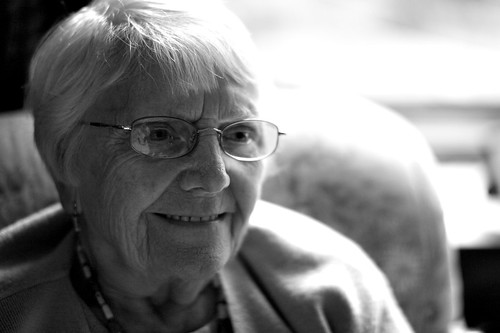
The first is a portrait that I took as part of my project that ran from 10/05/2007 to 09/05/2008 wherein I undertook to and succeeded in creating a portrait of a different person every day for a year. It is a portrait of my paternal grandmother taken under purely natural / available light in a snatched moment on one of my rare visits to the North West during that year.

365 Portraits - #170 ~ Dorothy "Nan" Godby

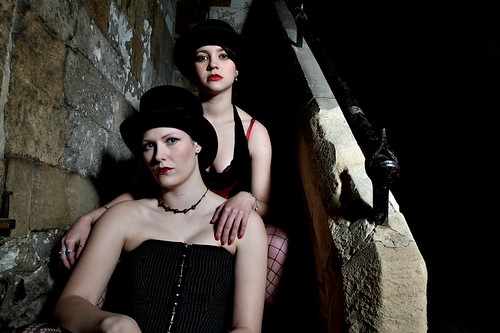
This second photograph is an entirely constructed picture, created in a kind of minimalist-strobist approach with a single, camera mounted flashgun, firing away from the subjects and to the right and bounced off a silver reflector held by an assistant. This gives the sharp, stark light you can see in the image, but it generalised the light so it is not as directed, giving compelling highlights and light in general to the surroundings as well as the models.

Scary Burlesque - Cathy and Bunny

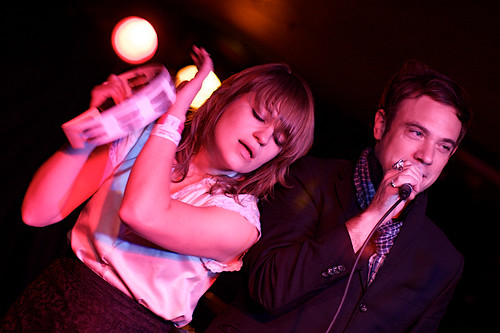
This third is an example of some of my gig photography shot with only the available light in the venue, and just to own up to it in advance, I was using a VERY wide aperture in order to keep the ISO as low as possible, but I don’t consider that cheating - I got the lens in America when the dollar was almost 2 to the pound!

The Airborne Toxic Event, Live in Bristol - Mikel and Anna

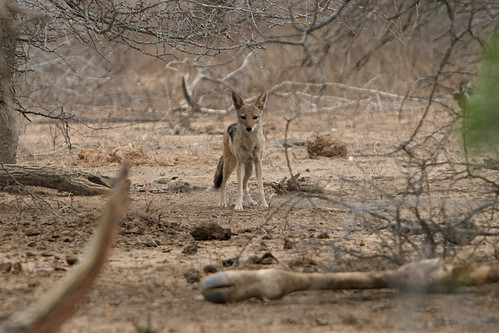
I have also developed an interest in nature photography on a recent trip to South Africa, and am now beginning the mammoth task of trying to save for another trip and the glass that my experience has told me that I am going to need to create the images that I want to create in that arena. Still some of the images that I managed to create on that trip were worth showing off, and so I leave you with this, captured on a cloudy morning in Kruger, at a doubled 200mm, with a stabilised Canon lens that I would not be without for love nor money:

Jackal

I’d like to thank the BLAB Blog for the invitation to be their Tuesday ‘Tog, and to offer any readers who are interested in seeing more of my work to visit my website here: http://www.techno-mage.co.uk/blog/photos/

If you want to be our featured 'tog on Tuesday in the coming weeks, then leave a comment on this post, it could be you here.

-blabpictures-

20 January 2009

Featured 'tog Tuesday - Chris Shepherd

Chris's Biog
I first became seriously interested in photography when I was given a digital point & shoot in the summer of 2002. To me this was a complete revelation, the power of digital immediately allowed me to see my pictures and mistakes. No more waiting for pictures to be developed and forgetting what it was I had in mind when I pressed the shutter release.

Within a few months I was producing results I was happy with, but wasn’t able to control exposure as much as I would now wish. So I then upgraded to a Fuji S602 which gave me plenty of control and allowed me to capture the beauty I saw in the world everyday.

In a fit of optimism I then booked an exhibition space a year in advance and planned to document a year in the life of our local nature reserve. To be honest I didn’t have a clue how big a job I had made for myself. The reserve is not the most photogenic place I could have chosen, so I really had to teach myself how to create images rather than just snapping what was there. The exhibition went well and as a bonus, I also made some sales to the public. Since then it has been a case of more photos, more equipment, more exhibitions and more sales.

In 2006 I was invited to join The Painting with Light Society www.painterswithlight.com a group of leading Landscape photographers based in the South East of England. I am also a moderator and the locations editor for the online photography magazine ePhotozine.com

My main areas of interest are Landscapes/Cityscapes and Abstract work.

The British Landscape and its nature is my first love. In the early morning light, much of the British countryside has a magical quality that is sometimes difficult to capture; but very rewarding when you do. I always feel a sense of pride in my work when people who have travelled all over the world ask “is that Britain?” It’s great to be able to show people the magic that is on their doorstep.

Cityscapes are a relatively new area of work for me; I have an ongoing project "London Light/London Life" documenting what I see in the city. I live very close to London but it’s not one of my favourite places at all. I am much more at home in the countryside than a busy city. However, I find it extremely challenging to find and produce good images of the busy city streets and architecture.


BLAB: What's your best bit of advice for a new photographer?
Forget about the technical stuff, learn to see first. You can spend hours fiddling with the controls on your camera or massaging an image in Photoshop but if the scene you are trying to capture doesn't express what you want you are wasting your time.

Try to develop the process I call “Active seeing”. This involves not just passively looking at a scene, but constantly evaluating even the most mundane scene from all possible angles, to find a composition that works as a stand alone image. Whether it actually represents the place you took the shot is not as important as producing an image that works on its own.

Spend a lot of your time drawing frames around a scene in your mind, ask yourself "what would I include in this scene if I shot it". Photography is all about the stuff you leave out, so identify what shouldn't be in there. Do some reading on composition, then take a look at loads of professional images and ask yourself does it work? what makes it work? and how you would have shot the same scene.

Once you know what you are trying to achieve it's time to start understanding the technology that allows you to achieve it.


BLAB: If you had been paid ten thousand pounds for being our 'Tuesday tog', what photo equipment would you spend it on?
I'm not really much of a gear head - though that doesn't seem to stop me spending a lot of money on it!

I think that I would spend £5000 touring my very favourite locations: New Zealand, The Canadian Rockies and Iceland. The other £5000 would cover my bar bill in Iceland - I'm not a heavy drinker but Iceland can be very expensive.


BLAB: Rucksack or shoulder bag and why?
Oh, err, um. Can I have both?

For landscape work it's the Lowepro Rover AW2 with room in there for 5 lenses, heaven knows why, I'll only use 2 of them at most, but it's always best to have the option. The top contains Lee filters and a nice thermos of steaming coffee for those cold mornings.

In the city it would have to be a shoulder bag or smaller, in these days of a war on terror (or the war on photography as I like to call it). The more inconspicuous you can be the less hassle you get from security and police. I often only use a Powershot G9, in the city - you can still get the shot but you also have the fun of watch photographers with tripods being hassled at the same time.


And finally...
BLAB: What colour would your Ferrari be?

Oh, Lime Green I think maybe with orange wheels, whitewall tyres and a nodding dog in the back. It's important to make a statement

Chris has also selected three of his favourite images to show on Blab:

Blea Tarn
I visited the Lake District twice last year. The first week, in the summer consisted of me opening the door every morning to be greeted by a solid wall of rain. The second started the same way. But finally after 3 days of solid rain the skies cleared. The rain had washed all the dust from the atmosphere creating vibrant colours and mountains that looked over sharpened to my eye. Looking at the resulting shot I think it was worth the effort.


Snow & Gate
Last winter I was really hoping for snow. So I was real chuffed when a huge dump of snow was forecast. Getting up before the dawn allowed me to have the pristine snow of my local nature reserve to myself (well just me and the Long Horn cattle who live there).

This is one of my favourite trees, I love it's big broad shape and have photographed it on many occasions.


Treads
I spotted these vibrant painted stairs on London's South Bank one afternoon. I simply waited till some feet appeared in just the right spot.


BLAB: Thanks for your time and images Chris. The lesson to look around close to home and see what you can produce is a good one. If people are anything like me, they feel the need to head off to foreign climes and take travel pictures, but that completely ignores the beauty we have to hand. Not taking what we have on our doorsteps for granted is a lesson we should all learn.

-blabpictures-

13 January 2009

Featured 'tog Tuesday - Martin Dyer

This week's guest photographer is Martin Dyer. Martin describes himself as a wildlife photographer who has a particular passion for bird photography. You can start by reading his biography:

Martin's Biog:
I started to take photos from the age of about nine when I was bought my first camera. My late teens involved lots of trips to motorcycle races and airshows, so I have packs and packs of very poorly processed 6 x 4 prints taken from the same corner of different motorbikes or aircraft taking off and landing. Very rarely was there anything of any great photographic merit, although I do recall taking pictures of the 1996 F1 Champion, Damon Hill, some time back in the 80’s, on Kawasaki Z500 production bike in a clubman’s race at Brands Hatch, on the inside of the track at Druids Hill hairpin, when you could actually do such things as a member of the public.

Photography fell a bit by the wayside through the 90’s as I was disillusioned with a lack of control of the whole process, and I couldn’t afford or even want my own dark room.
In fact I was about to sell off my EOS500N and two kit zooms when Canon launched the 300D. Well that got me back in to it in a big way. I had been into my wildlife for a long time and so this now gave me the opportunity to combine my two interests. So I suppose you could say I was a wildlife watcher first before photographer, which in some ways gives me an advantage in terms of subject knowledge and behaviours. My philosophy is firmly that the welfare and well being of my subject comes first and is embedded in the Nature Photographers code published by the Nature Group of the Royal Photographic Society

I take regular trips to the Isle of Mull to watch the wildlife there, probably the best place in the UK to see Golden and White Tailed Sea Eagles. Very difficult to photograph, as everything is at extreme range, but you have to keep trying from public locations and hope they come near you. Last year a photographer ‘s actions resulted in the failure of a Sea Eagles nest and the subsequent loss of the chicks, which is totally unacceptable and I believe a prosecution resulted. No picture is worth that.

There are sites in Europe where you can pay plenty of money to photograph them in more controlled conditions if that is what you want to do. But to me, I get the greatest satisfaction as a result of fieldcraft and patience, which usually involves a lot of cold and uncomfortable sitting or laying about, often with nothing to show for it.

I do a bit of printing work, usually for Photographic exhibitions, using both the Canon Pixma Pro 9000 and 9500, depending on what type of work I am doing. Both are excellent printers in their own right. Since I acquired the 9500, it has opened up the monochrome world to me and can finally finish some of my landscape work.

If you would like to see more of my work, then I have a blog with another wildlife photographer friend of mine, David Courtenay at Wildlife Across the Water. and also my own personal website at Martindyerphotography.co.uk that I will be updating and overhauling very soon.

As with all of Tuesday 'togs, we ask them a list of questions and they get to choose which ones to answer. We also one question they all have to answer:

BLAB: What colour would your Ferrari be?
Well if it had to be a Ferrari, then there is only ONE colour and it must be Red.

But why would I want a car that crashes into walls in airport tunnels in Manchester? – No for me it would be a Porsche GT2 – in bright metallic blue with gold wheels, configured just like the one I have on the Nintendo - Wii Need for Speed Pro Street as my grip car 

BLAB: If you had been paid ten thousand pounds for being our 'Tuesday
tog', what photo equipment would you spend it on?

As a wildlife photographer, I would buy the EF800mm f5.6L IS USM as you never can have too much length, and also the EF400mm f2.8L IS USM as it is not something that I could ever see myself purchasing ordinarily, and the results I have seen from it are stunningly sharp

BLAB: Rucksack or shoulder bag and why?

I use both depending on what I shoot. For studio work and people shots that I get dragged into doing, I tend to use an old Jessops shoulder bag – does the job OK.

For my wildlife and landscapes I have three rucksacks. When I am using the 500f4, I use a custom designed and made bag that will take the 500f4, with the hood fitted the right way round, with a 1.4 converter attached to my 1Dmk3, ready to shoot straight out the bag. When I am shooting from the car, it sits in the passenger footwell good to go, and then out in the field pretty much the same. A frustration with most other bags is that you have to build your camera/lens combination, by which time that rare bird or mammal is a small speck in the distance. It is an exceptionally comfortable bag, made by a fishing equipment manufacturer, that I can carry for a long time on my back.

My other rucksacks are the Think Tank Airport Acceleration – perfect bag for travelling by air. I can get my 1D, 500f4, 300 f2.8, 70-200f2.8, 24-70f2.8 and 17-40, plus 100f2.8 macro in, plus numerous other bits and bobs – great and complies with the smaller of the aircraft carry on sizes that some airlines insist on. The other bag I use from time to time is my Lowepro PhotoTrekker, usually for landscapes as it made of materials that seem to cope with the usually disgusting conditions that I end up putting my bag in

BLAB: Natural light or flash and why?

Landscape and wildlife are my preferred genre so therefore natural light is everything for those subjects. All my best wildlife images are down to the light, well in my opinion anyway. My landscape work is usually done in the golden hours of sunrise and sunset, although I won’t waste overcast and cloudy conditions to ‘see’ and take monochrome images, particularly when it works well with the subject matter. So while I do use studio flash from time to time for portrait and figure photography, and have even been known to use flash for wildlife, usually with the Kirk Flash Extender, it is not my preference.

Martin has also selected three of his favourite images to show on blab:

Milkcap fungus. I enjoy the challenge of macro photography particularly for fungus, and here the technique is all about the lighting. Compared to other natural history macro photography, fungi are really easy as they are not going to get up and run away, so the results are entirely down to you. I took this a couple of seasons back with my beloved old 1Dmk2N plus my trusty Canon 100f2.8 macro lens at my local woods. It was a fabulous season two years ago and I have kept my fingers crossed every year since, but have been sadly disappointed. M mode, ISO400, f20 and 1/5 s exposure. Using aluminium kitchen foil to reflect light back under the head of the fruiting body. An additional bonus with this particular specimen is the lactating gills, hence the name.


This shot was just a practice pan and so goes in the lucky file. I was out in Switzerland last year with my good friend and wildlife photographer, David Courtenay at Lake Geneva, trying to photograph in flight, landing on the water Goosanders. Dave and I would take turns throwing in the bread to attract them while the other took the shots. Sadly for us, somebody else was also feeding the birds a bit across the lake from us, which was distracting our subjects. It was a late Feb afternoon and the sun was setting just behind us. I saw two Pochards coming round towards the feeding activity, and as I often do just practice my panning and focussing techniques, with a suitable subject. It look pretty reasonable in the viewfinder so just gave it a double tap to squeeze off two images, and really thought no more about it and when back to my Goosanders. Well it wasn’t until I looked at them on computer that I realised how good the image looked. Moral of the story – always use any opportunity to practice your skills. Taken with the 1Dmk3, which still wasn’t fixed at this time, although this doesn’t look too bad does it? and my Canon 500f4L. Av mode, ISO 400, f7.1, 1/2000

I saw these stunning birds for the first time last year courtesy of a friend of mine who took me to the site. We watched up to seven in this one field over a number of days. Another image blessed with late winter afternoon sun coming on from the left. I blagged my partner Sue’s Canon 40D for this image to give me some additional ‘reach’ with my 500 f4 plus the 1.4EFTC to give me the best chance for frame filling images. M mode metered off the grass, ISO400, f7.1 and 1/1250. I was pleased to get a ‘Highly Commended’ for this at the Smethwick International Exhibition this year in the Nature Digital Projected section.

BLAB: Thanks for your time and answers Martin, they're very interesting and will hopefully help some of the readers either learn a bit or get inspired to go out and shoot more themselves. 

If any readers have any feedback or thoughts about Martin's work, hit the comments! Equally, if anyone else fancies being our featured Tuesday 'tog, let us know! 

-blabpictures-

6 January 2009

Guest tog Tuesday - James Corrin

Our first Guest tog on Tuesday is James Corrin who describes himself as a 31 year old fashion / alternative fashion / gothic photographer from Aylesbury UK. We asked James a few questions from a big list to kick things off.

BLAB: Natural light or flash and why?

JC: Almost without fail, flash. However, if you'd asked "available light or flash?" the answer would be "both".

There have been two things which really changed my photography. One of these was digital cameras, which makes the learning process so much easier (and removed film processing companies from the loop mercifully). The other was studio flash. Learning about flash really opened my eyes to light as a whole in photography, funny though it may sound - before that point I just took what light there was and consequently I have many mediocre landscape photos to show for it. Studio lights put me back in control and reinvigorated my interest in photography - but more than that, once you learn to control light you also learn how to see light. I think learning about flash is one of the greatest things any photographer can do, after studying composition. I think this is part of the success story of Strobist - it's not only that David Hobby is teaching people how to use flash, but he teaches them how to see and study light.

To get back to topic, I tend to approach any photographic problem as an exercise in using flash. I can't help myself, it's fun and I just like how flash looks in a picture, especially the ability to get soft-but-not-flat light sources. I do much of my photography in a studio, so I can craft my light from scratch. When faced with natural light I tend to work out how to minimise its impact so I can bring out the flashguns and shift the highlight of an image. Having said that, I am increasingly looking to blend available light, especially artificial light sources, with flash. And there are some occasions, such as at gigs, where available light is better than reconstructing the scene using flash.

So I guess the answer is rather unhelpfully, whatever is most appropriate to the picture.

... and flash.


BLAB: Which photographer's work do you most admire and why?

This is a very difficult question. There are so many photographers producing great work now and I find the ones I admire most change quite rapidly. Chiefly I look for photographers within my own field; landscapes are great too, but I photograph what I like to see. I make a point of looking at a lot of other photos, to get ideas, study technique and also plot a path to my own style. I'm trying to avoid copying other artists and, though I do praise Strobist, I want to avoid the "Strobist look" that has become quite common on the web.

That said, if pushed to name my influences, I'd have to cite two photographers, unfortunately you may find some of their images not safe for work, you have been warned:

Nadya Lev - her work was a strong inspiration for some time and even now I find it highly inspiring. Her work is fairly hard to place, but high-fashion with historical themes and fetish overtones might get close. My early experiments with gels and gothic fashion were largely brought on by seeing her work.

Lithium Picnic who also has a large body of work on deviantart.com - LP is in a similar line to Nadya Lev, with strong fashion and glamour pictures with varying levels of fetish fashion scattered around. Where Nadya Lev produces bright works with strong colours and simple constructs, LP produces darker and more complex pictures with more subtlty. I wouldn't say Lithium Picnic was necessarily better than Nadya Lev or vice versa, but I think I discovered his work at a time when I was looking to produce more complex images myself. LP is very much a target for my pictures, not so much in content but in look, feel and production values.

BLAB: Which of your images means the most to you and why?

Many of the photos that mean the most to me are little better than holiday snaps, but they represent people, places and things that were important in my life. As a photo, they aren't so valuable.

At risk of sounding a bit "arty", I think this is where the highly constructed images I make differ from, say, journalistic images. Because I am photographing constructed scenes, especially ones that may not exist beyond the duration of the flash, the image content has no direct meaning to me. I saw the studio that day and it wasn't anything special. Instead the photo is judged on its final quality - does it capture a mood or a look, is it stylish or attractive? And because I'm aiming to improve all the time, the image that means the most to me changes all the time, usually to the most recent image made.

I worry when my most recent images don't mean the most to me!

There is one big exception though. Two of my friends got married at the end of last year and asked me to be their wedding photographer. We did some lovely posed shots with flash inside the wedding venue. This was a wonderful chance to capture a memory and also dress it up in light. There's something very special about capturing a beautiful image of a beautiful memory.

BLAB: What would your dream photo opportunity be?

So many to choose from, but if Gothic Beauty magazine phoned up and asked me to do a cover, I wouldn't be complaining!

BLAB: What colour would your Ferrari be?

JC: Black, but with plenty of shadow detail. ;)

Anything else..?

These are very exciting times for photography since the rise of digital cameras and photo sites like Flickr and Deviant Art. There's an incredible amount of high quality photography out there. The best part is that not only is photography more accessible but learning about photography is more accessible. I wish Flickr, Strobist, Cambridge in Colour and so many other sites existed when I started in photography - maybe I'd have fewer boxes of mediocre landscape photos.

With all this photography around, there is a real issue about how you differentiate yourself. When I started in portraiture, I rapidly became bored as it all started to look the same. I started becoming interested in fashion photography and in particular gothic fashion, playing with different styles and variations from the alternative photography and fashion communities. There's an interesting trend now for mainstream fashion to borrow increasingly from these communities, but I like to think that it still gives my images original themes. I love working with the extended conventions of the alternative scene in any case so I can't see me stopping that any time soon.

I once attended a photography seminar where the organiser asked "Who takes photos because they can't draw?" Everyone put their hand up. I think flash photography really opens up the possibility to be massively more creative. Certainly the turning point for my photography was discovering studio photography. Prior to that I didn't find people very interesting subjects, but this introduction to a world where I could construct the entire picture, from selecting models to placing them in light that I controlled, added the important creative element that I was missing before.

There's a great comment I saw from Chase Jarvis originally and many other people since. He said, there's two kinds of photographer - image takers and image makers. I would definitely say I'm on the image maker side. Going digital has been a huge boon as now the image making can happen after the camera - I know some experienced photographers dislike doing their own post processing and consider edits to be cheating, but I consider digital workflow a huge advantage. Photoshop is a great tool and most of my portfolio images pass through Photoshop at some point. The trick is getting good quality images going into the workflow then being subtle in the changes. I've been through many dilemmas of Photoshop vs in-camera editing before realising that both sides have something to offer.


BLAB: Ok but what about photos, got any pictures you'd like to show us?


http://www.flickr.com/photos/captured_light/2848742273/in/set-72157603348085520/
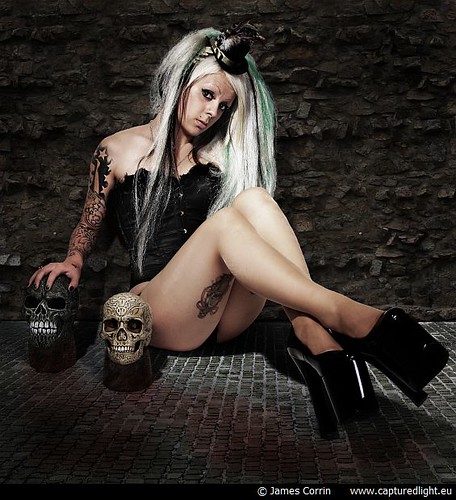
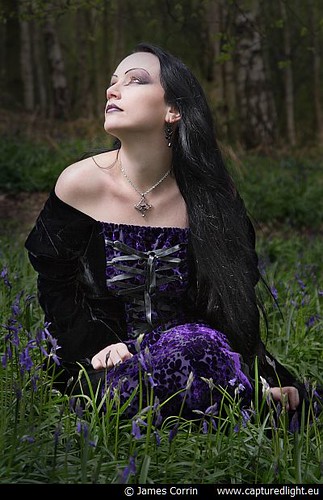
This image of Ethel Hallow is one of my favourites and she's always great to work with. This image also represents one of my biggest Photoshop edits to date. I couldn't find a good backdrop for her so took this picture on a white seamless studio backdrop. The original image was subtly lit and brought into Photoshop as a low-contrast image. I then took some segments of wall and floor from some holiday snaps and extended them across the picture, adding contrast and highlighting as I went. The advantage of shooting on white originally was that the shadows of Ethel on the floor effectively come for free through Photoshop blend modes. ... The skulls are real by the way, in as much as they are kickable objects in the scene with Ethel.


http://www.flickr.com/photos/captured_light/2848742135/in/set-72157603348085520/

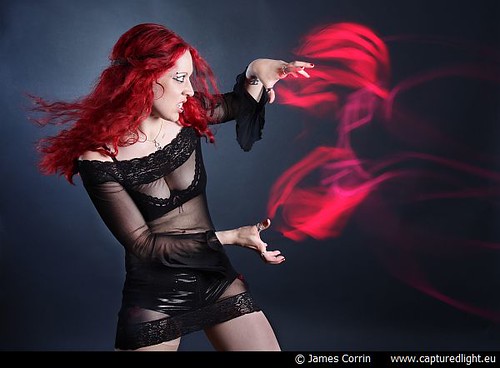
This photo amuses me because most people assume the red light was created in Photoshop. In fact, though the image has been edited slightly, the red light is created using glowsticks. The entire image was a 30 second exposure with willing model Skarlett Venom standing still in a dark room while I waved glowsticks in the air in front of her. Towards the end of the 30 seconds I jumped out of the way and fired three studio lights - one softbox from Skarlett's front, one hair light to the left and a blue gelled light on a black paper backdrop.


http://www.flickr.com/photos/captured_light/2079023381/in/set-72157603348085520/
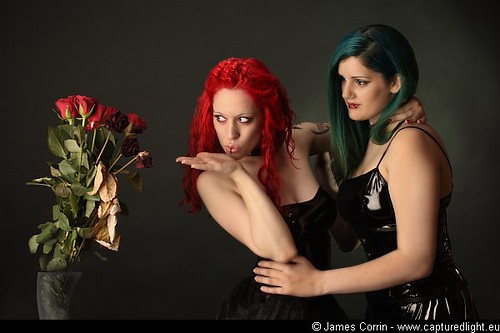
One of my early, big-team studio efforts and my first time with a makeup artist on set. No-one quite seems to get the concept I had in mind for this shot, but so far it's fairly well received. Thanks to the cooperation of Skarlett Venom and Indira Diabola, not much editing was required on this image. The only big change was the vase - I couldn't find an interesting vase before the shoot so had someone hold the flowers up and drew a vase in Photoshop over the hand after the event. I've learnt more about drawing through Photoshop than anywhere else.


http://www.flickr.com/photos/captured_light/3168339659/in/set-72157603352325505/
This simple photo was taken outside on an overcast day. It's fairly true to the real view, but I did use a flashgun with brolly top-left to get a directional light on Amaranth's face. I've invested in a few Canon speedlites and find them invaluable for studio photography outside the studio. The wireless trigger isn't great in direct sunlight but a bit of cloud cover helps massively. A little Photoshop after the event brought out some more detail in the purple of the dress.


http://www.flickr.com/photos/captured_light/3168339669/in/set-72157603348085520/

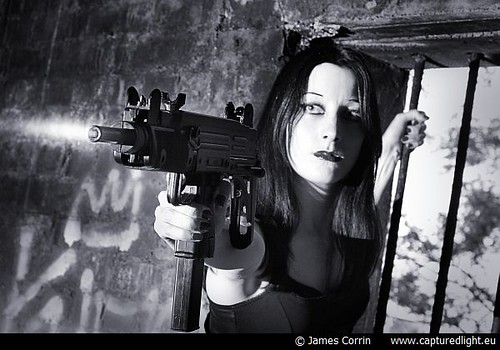
I don't often work in black and white, but this picture of Marvada and her replica machine gun cried out for it. It was photographed on a sunny day but in a dark room, so the speedlites came out again to swap the lighting from window-inwards to room-outwards. I love being able to re-engineer light on set like that. The muzzle flash is a Photoshop extra - just in case I'm not bullet proof.

James' photography and writings can be found in several other places on the web, most notably his website, www.capturedlight.eu.
Then there is his flickr account www.flickr.com/photos/captured_light/and techie and photo blog: jordax.livejournal.com/

Wow what a start, think you want to be here on Tuesday, drop a message to us or comment on this post.


-blabpictures-

16 December 2008

Your opportunity to be the featured photographer on Tuesday

Hoping that you've noticed the previous Tueday postings have been mostly to highlight individual photographers and their causes, this is your wake up call to get in on the act. With traffic climbing here on a weekly basis this could be a great chance for your own promotion in 2009.

We're now contacting and collecting photographers for selection as the guests for something we termed Tuesday Tog. You get the opportunity to answer some of our questions, share some of your most inspirational work and even blatantly promote your own online presence or cause. If this sounds like something you'd like to be part of then leave some comments for us or by email to blog 'at' blabpictures -dot- co -dot- uk, sorry about the adress spacing but if you're human you'll understand. Mark the comments with DON'T PUBLISH in them and that way your details won't be all over the web - yet or again.


It's just before this post goes live, and I've just read a peice about being a professional photographer penned by Joe McNally on his blog. Ignore the title, it's a peak inside the mindset of a photographer with a mesmerising narrative that means you'll loose about 5-10 minutes whilst you read it yet gain some pearls of wisdom once you understand it. What's more Jason over at CanonBlogger has a great peice about the difference between male and female photographers.

Time to get out there and make contact, male or female you could be the photographer offering your insight for free and reaping the rewards as one of our Tuesday togs.


-blabpictures-