Showing posts with label macro. Show all posts

13 May 2009

Diffusers

I was teaching the other day and the subject of reflectors came up. I'm not sure how but we ended up exploring the difference between a reflector and a diffuser. Now, while most people can understand what a reflector might do, the idea of using a diffuser between the subject and the sun is a little harder to understand, so I thought it best to demonstrate using two pictures....

1.


The first image is direct sunlight falling onto the flower head. The second image has a diffuser between the flower and the sun casting a big shadow. Which do you prefer?

2.


If you're struggling with the concept of reflectors and diffusers, here's a simple way to remember what does what:
Reflectors work to reduce shadows, diffusers work to reduce highlights.


-blabpictures-

8 May 2009

Photographing butterflies


It's that time of year when butterflies are starting to appear and thoughts turn to how best to capture them 'on film'. For many people, the first thought is to turn to a macro lens - the EF100mm f/2.8 USM being a favourite. However, the reality is, unless your butterfly is very still - early morning for example - the 100mm lens is not really going to cut the mustard. More usefully, the EF180mm f/3.5L Macro USM lens will give you a greater working distance while still providing the magnification you're looking for.

However, for many the 180mm macro is a little out of budget for such a specialist item. A really good butterfly combination is to put together two tips we've previously the talked about on the site: The EF70-200mm f/4L IS USM and Extension tubes.

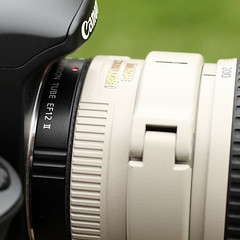
If you put these two togther, you can get closer than the 1.4m minimum focus distance of the lens would usually allow, and also increase the magnification - up to 0.42x (nearly half life size) with an EF25 II tube. This gives you the flexibility to zoom as well, and has the added advantage that when you use extension tubes, you can really blow out the background to keep the subject standing out.

-blabpictures-

5 May 2009

A star in the range - EF100mm f/2.8 Macro USM

The second part of our 'star in the range' series sees us looking at the EF 100mm f/2.8 Macro USM lens. Those of you with this lens will know how good it is, those without can only wonder what all the fuss is about. The truth is, this lens really is quite remarkable. It offers full 1:1 (lifesize) reproduction without having to change the length of the lens when focusing, and the results are stunningly sharp. So sharp in fact, that a common question asked is "Why is it not an L-Series lens?" The answer is that it doesn't use some of the technology required to make it an L-Series model, however the optical performance is more than enough to justify it.

If there are any complaints leveled at this lens, it's that it is in fact too sharp in some situations. Portraits usually. This lens seems to resolve detail that you just don't see, meaning that in a portrait shoot (for which the 100mm focal length is actually very useful) you end up with lots of images that need retouching to remove skin blemishes you didn't know where there!

So, should you buy it? Well, if you want to get into macro photography, it is the obvious choice in the range. The MP-E 65mm f/2.8 1-5x Macro photo is too specialised and lacks the ability to focus at infinity, the EF50mm f/2.5 Macro only does shalf life size unles you add the life size adaptor and the EF180mm f/3.5L Macro USM is more designed for subjects that need a longer working distance - butterflies and dragonflies for example. The 100mm is the all-rounder. You can shoot insects with it as long as you're careful about what you're doing, you can get in close to flowers and fungi and you can use it for portraits and general photography.

Is there anything missing from this lens? Well, I wish they'd box it with a lens hood included and I'd like to have this lens with an image stabiliser fitted like the N!kon VR Macro lens. Other than that though, it's a stunning lens that anyone interested in macro photography should seriously consider.

Have you got one? If so, what are your thoughts on it? Would you buy it again if you had to?


-blabpictures-

15 April 2009

Closer than the minimum focus distance

Extension tubeDo you ever hit the 'subject too close' limit with longer lenses? Wouldn't it be great if that 70-200mm lens with it's 1.2m closest focussing distance could be used even closer sometimes?

The EF12 II and EF 25 II extension tubes move the closest focus point of your lens even closer. Macro photography with an EF 500mm f/4L IS USM anyone?

Extension tubes are tools that some photographers see as only for macro work, but you can use them with a lot of lenses not just macro ones. Moving the rear of a lens further away from the sensor means that it will focus the light from closer subject distances than it can do normally, the downside - you can't focus on infinity anymore.

Some years ago Canon used to show a video with wildlife photographer greg Basco shooting snakes in trees using an EF 300mm f/2.8L IS USM lens with an extension tube on the back allowing much closer focussing.

In the past I've found the extension tube a neat solution to the problem of shooting through glass at zoos. In some cases you need to have the lens right up against the glass to reduce the reflection, but then the subject is too close for the minimum focus on the lens. Put on the extension tube and the problem is solved.
These two shots were taken with an EF 70-200mm f/4L IS USM lens at it's minimum focus distance, the first with the lens only, the second with an EF 12 II extension tube fitted between lens and camera.

200mm close focus 200mm close focus with 12mm extension tube

You can now focus at distances less than 1 metre from the subject but maximum subject distance becomes just less than 5 metres with the lens set to infinity.

When Canon introduced EF-S lenses with the EOS 300D it changed the extension tubes so that they could be used with EF-S lenses as well as EF lenses. This makes it possible to use an EF-S 18-55mm f/3.5-5.6 kit lens as a macro lens on an EOS-1Ds Mark III, but the subject distance is very short. Some wide-angle lenses aren't compatible with extension tubes as the point of focus moves to a point inside the lens itself.
For the technical or the inquisitive readers you can also combine extenders like EF 1.4x II or EF 2x II with extension tubes for even more magnification.
Extension tubes may make the automatic peripheral illumination correction available in DIGIC 4 cameras insufficient, and likely it will render flash distance information wrongly too.

-blabpictures-

24 January 2009

Reflecting on things

IMG_8812
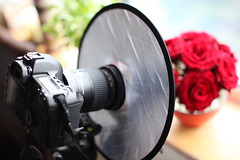
So there I was chatting to a photographic distributor friend of mine and he asked if I'd seen this reflector he had. It's called the Matin macro reflector and while I normally steer well clear of what at first glance would appear to be a gimmick, I was intrigued. I have used both the Canon MT-24EX and MR-14EX macro lites extensively in the past and they are both great, but not suitable for everything...or indeed affordable to everyone.
This reflector is clearly not a replacement for one of these units as they offer so much functionality, but for some situations this might be just what you need.
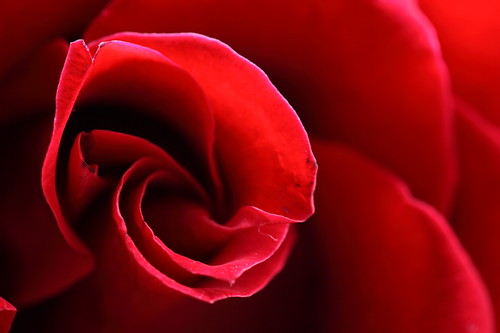
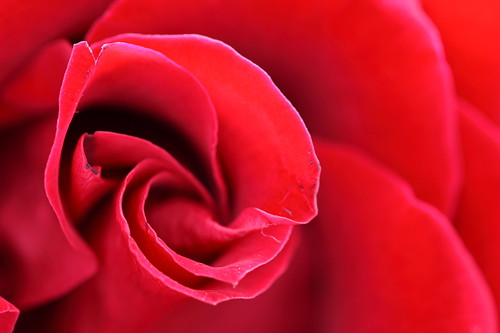
Take this rose picture for example. The light was coming in from behind the rose bunch and although a macro lite would have done the job, this little couple of quid reflector has done it quite nicely. Nothing else changed in the setup - not even the exposure - so you can see how much light it has put back into the subject.

The reflector has both a silver side and a silver/white side so you can vary the light coming off it and if you wanted to introduce some level of modelling with more light from one side than the other, it would not be difficult to tape some paper or material over half the reflector to cut down the reflection from that side.

It fits over the front of the lens so that it is inline with the subject and where the lens points. I found that it's a tight fit onto the lens hood of my EF 100mm f/2.8 Macro lens, but it does go. Without the lens hood it will fit back onto the body of the lens around the focus ring. On thinner lenses you might need to use the velcro straps to keep it in place.

The moral of the story? Sometimes simple works. Don't discount something just because it's cheap or looks gimmicky. sometimes it will be a a cheap gimmick, sometimes it might just provide an alternative solution.

Without a reflector
_MG_4188


With a reflector
_MG_4189


-blabpictures-